Dictionary of Psychotherapy by Walrond-Skinner Sue
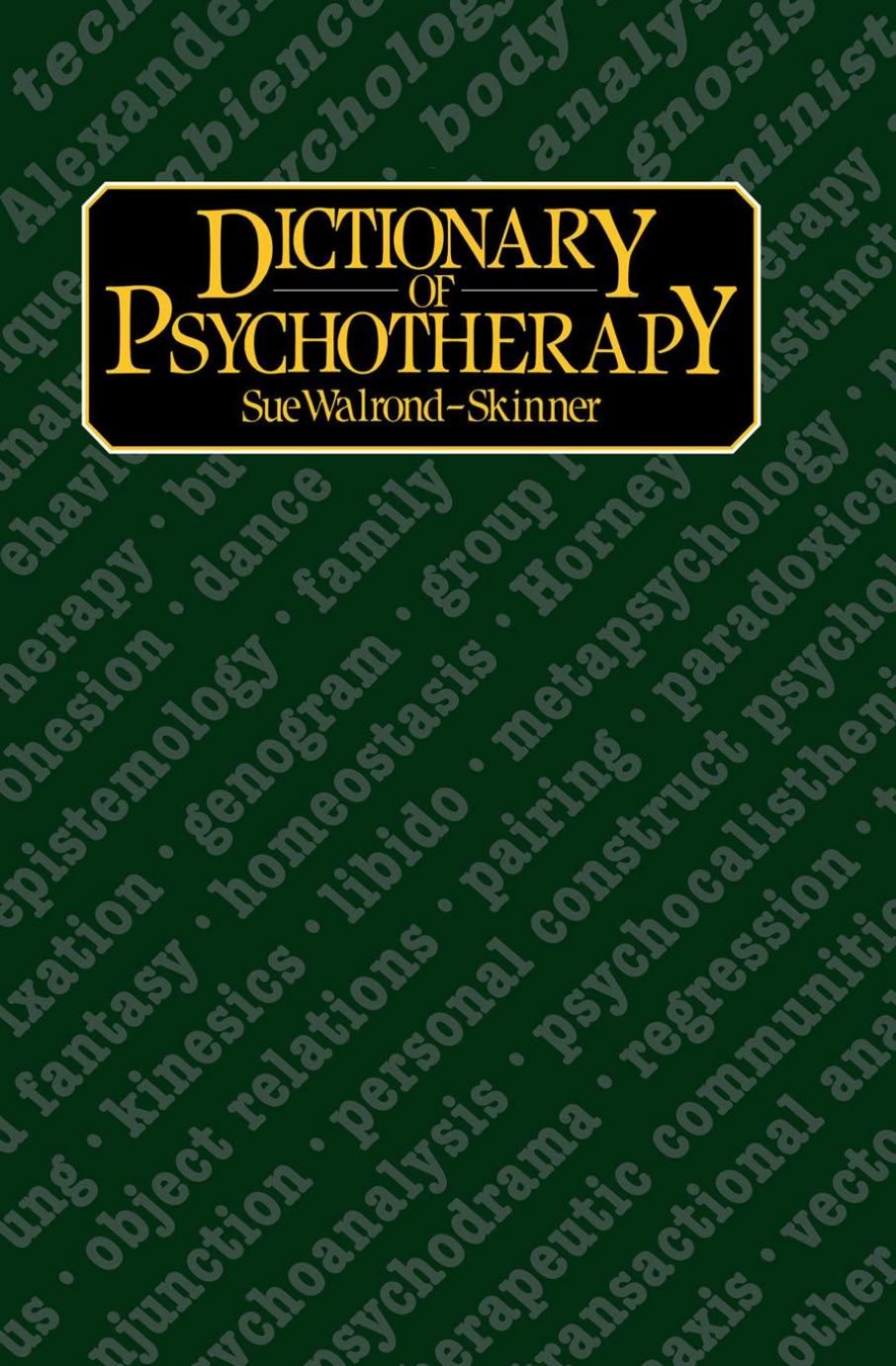
Author:Walrond-Skinner, Sue.
Language: eng
Format: epub, pdf
ISBN: 9781317793335
Publisher: Taylor & Francis (CAM)
Interpretation
A communication from therapist to patient designed to elucidate the unconscious meaning and repressed wishes which lie beneath his dreams, free association, use of symbolism, resistance, symptoms and/or feelings towards the therapist expressed through the transference. Within psychoanalysis, the purpose of an interpretation is to make the unconscious conscious or to raise the primary to the secondary process. Although interpretation is the chief tool of the analyst and his primary form of activity in the treatment, interpretation is also used in many other forms of psychotherapy and within other modalities such as family therapy and group psychotherapy. Rules governing the level, type and timing of interpretations relate to different approaches to psychoanalysis and to different forms of psychotherapy. The activity involves, first, an understanding of the material by the therapist, and second, the communication of that understanding to the patient in a manner which will be acceptable to him, that is, ego syntonic. Care must be taken that the interpretation does not break the patient's defence mechanisms prematurely or brutally. The interpretation of dreams was offered by Freud (1900) as a paradigm for all interpretations, although Jung (1954) criticised what he felt to be Freud's stereotyped interpretations of dream symbols. Strachey (1934) formulated an influential model of the way a ‘mutative’ interpretation results in change in the intrapsychic structure.
Most psychoanalytic theorists emphasise the importance of transference interpretations over all others, though Leites (1977) has challenged this view. In her discussion of transference interpretations, Segal (1973) suggests that a full transference interpretation ‘should include the current external relationship in the patient's life, the patient's relationship to the analyst and the relation between these and the relationships with the parents in the past’, though she admits that this is seldom possible to do fully.
In psychoanalysis, interpretation is generally regarded as the tool which holds greatest potential for being either curative or harmful to the patient. The function of an interpretation is to promote insight and bring about integration within the psyche and an interpretation that brings about these changes in the patient is termed a mutative interpretation.
CHESHIRE, N. M. (1975), The Nature of PsychodynamicInterpretation (Wiley, London).
FRENCH, T. (1970), Psychoanalytic Interpretations (Quadrangle Books, Chicago).
FREUD, S. (1900), ‘The interpretation of dreams’ (Standard Edition, vols 4 & 5, Hogarth Press, London).
JUNG, C. G. (1954), ‘The practical use of dream analysis’ (Collected Works, vol. 16, Routledge & Kegan Paul, London).
LEITES, N. (1977), ‘Transference interpretations only?’ (Int. J. of Psychoanalysis, vol. 58, pp. 275–87).
SEGAL, H. (1973), Introduction to the Work of Melanie Klein (Hogarth Press, London).
SPRINGMAN, R. R. (1970), ‘The application of interpretations in a large group’ (Int. J. of Group Psychotherapy, vol. 20, pp. 333–41).
STRACHEY, J. (1934), ‘The nature of the therapeutic action of psychoanalysis’ (International Journal of Psychoanalysis, vol. 15, pp. 127–59).
Download
Dictionary of Psychotherapy by Walrond-Skinner Sue.pdf
This site does not store any files on its server. We only index and link to content provided by other sites. Please contact the content providers to delete copyright contents if any and email us, we'll remove relevant links or contents immediately.
Unwinding Anxiety by Judson Brewer(73422)
The Art of Coaching by Elena Aguilar(53651)
The Fast Metabolism Diet Cookbook by Haylie Pomroy(21256)
Rewire Your Anxious Brain by Catherine M. Pittman(18797)
Healthy Aging For Dummies by Brent Agin & Sharon Perkins RN(17123)
Talking to Strangers by Malcolm Gladwell(13540)
The Art of Thinking Clearly by Rolf Dobelli(10719)
Mindhunter: Inside the FBI's Elite Serial Crime Unit by John E. Douglas & Mark Olshaker(9523)
Crazy Rich Asians by Kevin Kwan(9419)
The Compound Effect by Darren Hardy(9151)
Tools of Titans by Timothy Ferriss(8593)
Periodization Training for Sports by Tudor Bompa(8417)
Becoming Supernatural by Dr. Joe Dispenza(8368)
Wonder by R. J. Palacio(8241)
Bodyweight Strength Training by Jay Cardiello(8029)
Crystal Healing for Women by Mariah K. Lyons(8007)
Change Your Questions, Change Your Life by Marilee Adams(7931)
Nudge - Improving Decisions about Health, Wealth, and Happiness by Thaler Sunstein(7853)
Should I Stay or Should I Go? by Ramani Durvasula(7780)
